|
creators of the Young Canadian Leadership
Challenge.
The program, now in its fifth year, was held in Cantley, Que., between Friday and yesterday. With volunteers playing the roles of medieval characters, participants -- boys were knights and girls were princesses -- were put into groups of eight and faced their first challenge almost immediately: building shelter for the next two nights from provided supplies. "When I first got here, I was really confused; I didn't know what we'd be doing and I thought we'd be sleeping in cabins," said Hailey Pennock, 13, of Ottawa, adding that she enjoyed the weekend and learned some important things about herself. "I learned that I am patient and that I can put up with people who annoy me without yelling at them." |
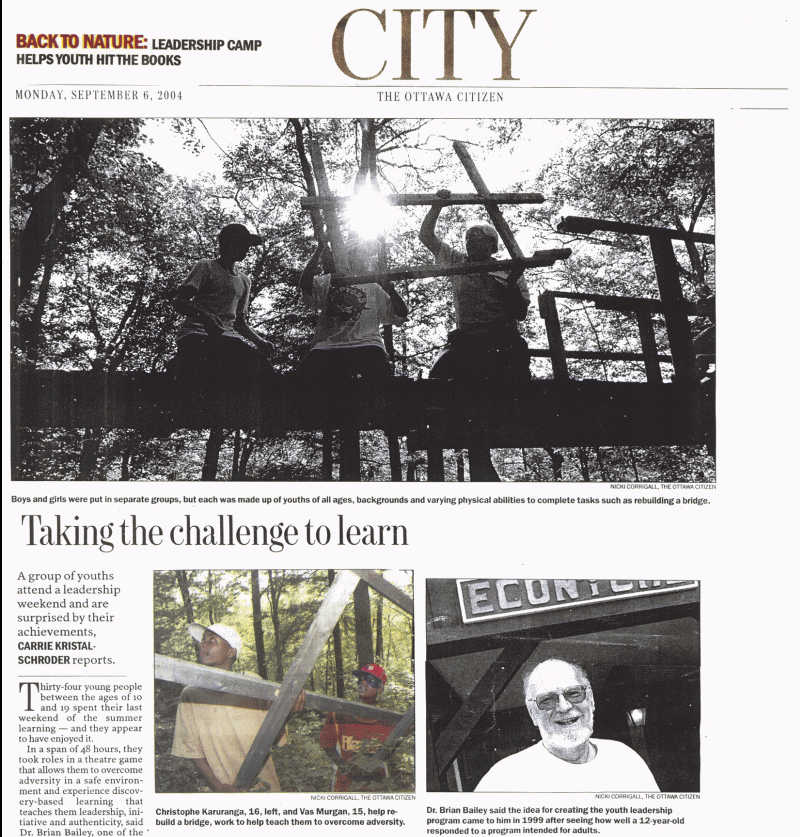
Boys and girls were put in separate groups, but each group was made up of youths of all ages, ethnic and economic backgrounds and widely varying physical abilities. After each challenge, such as scaling a three-metre wall, or going through a ropes course -- the groups would hold a "high council meeting." Participants would then receive beads representing the qualities they had shown during the exercise -- red for heart, for instance, and blue for pro-action -- and the teams were given pieces of a puzzle that, put together, made a treasure map, said weekend volunteer Dr. Marie-Madeleine Bernard. Having the most beads didn't add up to being the winner, and every team and individual put their puzzle pieces toward the treasure map, which led to cake and other goodies. "As elders, what we try to do is let the kids see new talents that they didn't know they had -- but we have to do it with very little intervention. We let them figure out the challenge -- we give the rules, but no support and no clues." For 13-year-old Kevin Murison of Ottawa, the program appeared to have met its objective. "I learned that I'm a lot better at leadership and speaking up for myself than I thought," said Kevin, adding that his father died two years ago and his mother found out about the program from the Big Brothers organization. Dr. Bailey said while some participants hear about the program through youth organiza |
tions such as Big Brothers, most young people come after hearing
about it from a friend.
"Youth will usually only take a risk on this if they hear about it from their peers, so most of the interest comes from the excitement of other young people who have attended." Dr. Bailey said the idea for the youth leadership challenge arose when he went to an adult leadership weekend that was attended by a 12-year-old boy from Vancouver in December 1999. "This 12-year-old was there by himself and in no time he had all of the adults in the palm of his hand, but he was not an imitation adult -- he was his own person," said Dr. Bailey, adding the boy's impressive abilities shone after he had gone to a leadership program for youth that was specifically intended to teach fathers good parenting skills. But after each session, they discovered that the program was having an extremely positive effect on a few of the young boys participating, and Dr. Bailey, along with several others, decided to try to create a program in which all the young people come away with self-confidence, initiative and respect for others. |
And Dr. Bailey said that not only is the program succeeding, but the lessons learned have "stuck" even with those who participated in 2000, the first year of the program. One of the original participants was Manou Sokpor, 23, who came back this year as a volunteer. He agreed the program had a significant impact on how he has developed as an adult. "I never knew that I could be a leader or speak in front of people. And the elders teach you to trust yourself and have confidence," said Mr. Sokpor, who plans to go back to school to become a police officer, but is currently working in order to support himself and his younger brother. Dr. Bailey said one of the reasons the two-day program can have such a lasting impact is because as soon as the learning takes place, there is immediate feedback, which reinforces the lesson. To provide a measurement of the programs' success, Robin Westmacott, a second-year master's student in psychology at Carleton University, is undertaking a study of the program over a three-month period. |
LEARN: 'Elders' help youths find their hidden talents. |